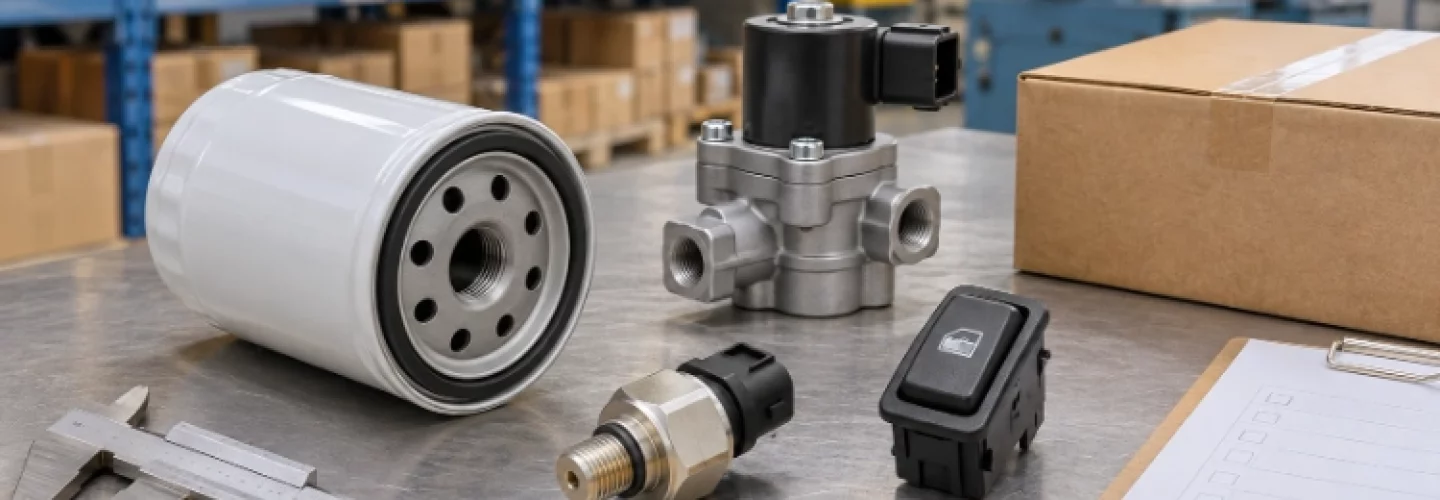
A repeat filter order may suit a factory that already makes the part. Add pressure sensors, switches and solenoid valves to the same list, and you may need several manufacturers. A trading company can coordinate those sources through one point of contact.
For importers and distributors, the better route depends on product coverage, order volume and the work involved in managing suppliers. Compare the total purchasing cost and the support each supplier can provide.
Truck Parts Manufacturers and Trading Companies
A manufacturer produces parts within its own manufacturing operations. A trading company sources parts from different manufacturers and coordinates supply. Some factories also sell sourced products. Some trading companies invest in factories or develop products with them.
The table shows common arrangements. Confirm the actual product sources and service scope with each supplier.
Purchasing issue
Direct factory order
Trading company order
Product coverage
Usually focuses on the factory’s own production range.
Combines products from several manufacturers.
Specifications
The buyer communicates directly with the producer.
One coordinator follows up with each manufacturer.
MOQ
Set by production needs for each item.
Still applies by item. Categories can be combined.
Quality checks
The factory manages production checks and agreed inspections.
Coordinates checks across sources. Warehouse capabilities vary.
Shipment
The buyer coordinates each factory’s packing and handover.
Can coordinate receiving, packing and consolidation within the agreed scope.
How CHANCEPAR Works with Manufacturers
CHANCEPAR is a China-based trading company and supply integrator. We maintain close oversight of our core manufacturing partners. We hold equity stakes in selected factories, including manufacturers of air brake components and switches. These relationships support closer control over product requirements, production coordination and quality follow-up.
For selected products, we also work with manufacturers on product development and hold exclusive sales rights. We operate our own warehouse and directly manage packaging for every order. All products pass through our warehouse inspection process before shipment.
When Buying Directly from a Factory Makes Sense
Factory-direct sourcing often suits a focused product range with stable specifications and repeat demand. If your volume meets the production MOQ, the factory can plan production around a clear requirement. Direct communication can also make discussions about samples and technical changes easier.
This route can work well for an importer with an established sourcing team. The team can qualify manufacturers, follow production and arrange inspections and transport. Managing several factory relationships may be practical when each category has enough purchasing volume.
A lower unit price should be weighed against the stock you need to hold. A fast-selling filter and a slower-selling sensor may have very different demand. Buying extra units to meet an MOQ can tie up cash. Sample costs, separate pickups and supplier follow-up also affect the total cost.
When a Trading Company Adds Value to Mixed Orders
A mixed shipment also needs usable receiving information. Require the packing list to distinguish each reference and quantity, and agree how cartons will be labelled. If private-label boxes are required, approve the artwork and product identification before packing. The receiving team can then check the individual items without treating a mixed carton as a single stock item.
This is useful for distributors that need broad coverage but have limited staff to manage factories in China. The value comes from selecting suitable manufacturers, resolving product questions and coordinating the order. The supplier’s ability to carry out that work matters more than its business label alone.
At CHANCEPAR, we review the parts list and select suitable manufacturing resources. We follow up on quotations, missing information and production schedules. Goods from different suppliers enter our warehouse for verification, packaging and consolidation. We also coordinate quality investigations with the relevant manufacturer when an issue occurs.
If one supplier is late, we discuss whether to wait or arrange a partial shipment. This gives the buyer one point of contact for decisions affecting the overall order.
What to Verify Before Choosing a Truck Parts Supplier
Whether you choose a factory or a trading company, confirm the product requirements, inspection arrangements and order terms before placing a bulk order.
Confirm Part References and Vehicle Applications
Send OE or cross-reference numbers, or clear photos of product labels, together with quantities. Add any available specifications, vehicle details and packaging needs. We can clarify missing information during the sourcing review.
Use our truck parts search to search the partial online catalogue by OE or CHANCEPAR number. Send unlisted items to us for review.
A matching reference alone does not establish complete interchangeability. Compare the vehicle application and critical specifications for the proposed item. Depending on the part, these may include dimensions, mounting points, connectors, threads, ports or electrical ratings.
Keep the identification fields separate. An original reference, a cross-reference and a supplier’s internal number serve different purposes. Record which proposed product has been checked against the requirement, then retain the approved drawing, specification or sample identification with the purchase order. Review and approve any substitute before supply.
Clarify Product Checks and Supporting Documents
Review the manufacturer’s production and testing capabilities, sample results and quality history. For a management-system certificate, verify the holder, covered site, scope and validity.
CHANCEPAR combines manufacturer checks with warehouse verification. Factory-side checks cover production requirements and finished-product assembly, appearance, markings, dimensions and required functions.
Warehouse verification covers the following points, as applicable:
Appearance, visible damage and packaging condition.
OE and cross-reference information, product markings and labels.
Quantities and shipping marks against the order.
Key dimensions and comparison with approved specifications or samples, where applicable.
Customer-specific packaging and other confirmed inspection requirements.
Every incoming batch enters our receiving inspection process. Before dispatch, we verify the prepared order and packaging. Inspection methods and sampling levels depend on the product category, batch size, quality history and customer requirements.
For functional testing or specific test reports, agree on the scope, responsible party and required records before order confirmation. Supporting records should relate to the approved product and the relevant order or batch.
See how we handle quality assurance and warehouse verification.
Confirm MOQ Packaging Delivery and After Sales Terms
Confirm the MOQ for each part and any separate minimum for custom packaging by size or format. Check sample fees and the expected ready date. Compare quotations using the same specifications, quantities, packaging and delivery terms.
Record the agreed Incoterms® rule and its named port or place. The rule allocates delivery responsibilities, costs and risk. Agree separately on the inspection and acceptance arrangements.
Review the warranty period, exclusions and claim process. For a CHANCEPAR claim, request the official claim form. Provide the CHANCE Lot No., affected quantity and clear evidence of the issue. We may request a return for inspection. Claims are assessed under the applicable Warranty Terms.
Choose a Sourcing Route That Fits Your Order
Direct factory purchasing may suit a focused product range, repeat volumes and a team able to manage production and delivery. A trading company can be a practical choice when your order spans several manufacturers and you need coordinated sourcing and shipment preparation.
CHANCEPAR is a China-based trading company and supply integrator serving overseas importers, distributors, wholesalers and parts brands. We focus on European heavy-duty trucks and American Class 8 vehicles. Our factory investments, selected joint-development projects and own warehouse support closer coordination from sourcing through dispatch.
Submit your parts list for a sourcing review.
FAQs
Is a factory always cheaper for truck parts
A factory may offer a lower unit price. The total cost also depends on MOQ, extra stock, inspection arrangements and shipment preparation. Compare quotations on the same basis.
Can a trading company combine parts from several suppliers
Yes, if it has the receiving and consolidation capabilities to do so. At CHANCEPAR, goods from different suppliers enter our own warehouse for verification, packaging and shipment preparation.
What information do I need to start a truck parts inquiry
Send the OE or cross-reference numbers you have, or clear photos of product labels, plus the quantities required. Add any available specifications, vehicle details, destination and packaging needs. Mark any information that still needs confirmation.
CHANCEPAR operates exclusively as a business-to-business (B2B) trading enterprise. We supply independent aftermarket heavy truck components strictly to verified corporate partners. To maintain the efficiency of our supply chain and protect our commercial pricing structures, we do not service individual retail consumers or “DIY” purchasers.
2. Eligible Entities
We grant access to our technical specifications, OE cross-reference systems, and commercial pricing only to the following professional categories: Regional Distributors: Wholesalers and importers with established distribution networks. Fleet Operators: Entities managing verified commercial vehicle fleets. Certified Workshops: Specialized repair facilities for European heavy-duty truck brands.
3. Verification Process & Communication
To request a quote or technical data, applicants must provide verifiable corporate credentials. Comprehensive Identity Verification: If necessary, we may require sufficient information to verify your status as a legitimate B2B buyer. This may include your official company name, website, corporate social media profiles, or other relevant business credentials (you are not required to provide all of these, only enough information to verify your identity). Business Email Required: Inquiries must be submitted via a registered corporate email domain. Submissions using generic email providers (e.g., @gmail.com, @yahoo.com) will be automatically filtered or require secondary business verification (such as a valid company website or Tax ID). Commercial Alignment: Our operations are designed for international trade supply chains, typically operating on standard B2B fulfillment cycles with roughly 50-day lead times. We require applicants to possess corresponding commercial purchasing capabilities.
4. Compliance Enforcement
CHANCEPAR reserves the right to audit the corporate credentials of any applicant. Any attempt to misrepresent commercial status in order to access wholesale pricing or technical data will result in immediate rejection. We reserve the right to permanently revoke access to our catalogs, pending quotations, and technical support without further notice.

 If one supplier is late, we discuss whether to wait or arrange a partial shipment. This gives the buyer one point of contact for decisions affecting the overall order.
 If one supplier is late, we discuss whether to wait or arrange a partial shipment. This gives the buyer one point of contact for decisions affecting the overall order.